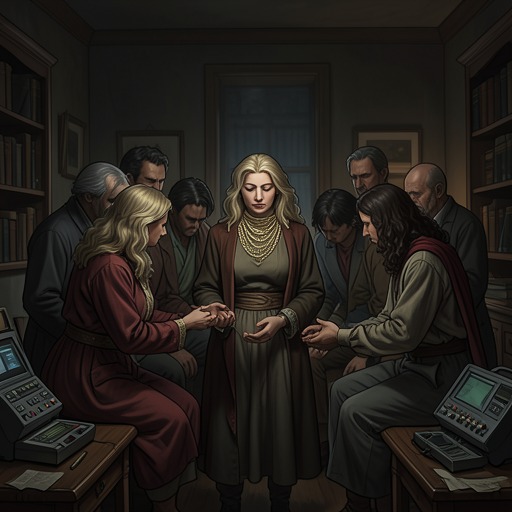
“Who am I”
The Passage (Justin Cronin Edition)“Who am I?” is the recurring question through which the novel gives voice to the infected and links their condition to Amy’s search for identity. First heard as a demand the dreaming dead press upon her, it follows Amy through her years alone; at the story’s climax, the question remains, but the voices asking it are no longer bound to Babcock’s dream, and Amy understands that she can return their individual stories to them.
The question in Amy’s solitude
The expression takes shape during Amy’s solitary life after separation from the people she remembers as the Man and his companions. She recalls them unevenly, then confronts the thought that she is alone: “There is no I but I.” She learns to walk in the light, though it is difficult, and travels in the direction the Man had told her to follow. The question of who she is thus arises not as an abstract puzzle but from the absence of other people and the uncertainty of what she has become.
The voices complicate that isolation. Amy hears the Man in the wind and among the stars for a time, but his voice gradually blends with those of the other dreaming souls. Her account presents these voices as a presence that is also an absence: a world of souls who seem unable to die, yet cannot tell her who she is. The repeated question—“Who am I? Who am I? Who am I?”—belongs to Amy’s own uncertainty as well as to the voices around her. It makes identity a shared problem, not a private answer she can find simply by remembering her former life.
From haunting to encounter
The question becomes an encounter when Amy realizes that the dreaming ones have followed her. In a cold barn, she wakes surrounded by their faces and understands that they need her to answer. She runs from them, but flight does not resolve the connection. Later, when more of them gather around her, she touches them and asks whether they are all there is, and whether there is no self beyond her own. They offer no answer; they repeat the question instead. Amy discovers that she can send them away by willing them to go, a capacity that changes her relation to the voices without explaining their identity or her own.
Much later, after she has sheltered a man and tried to keep the dreaming ones from killing him, Amy seeks the men who have gone away. She asks the darkness where they are and describes herself as having been alone through all the years, “no I but I.” A voice from the night sky tells her to go into the moonlight and find them. When it calls her Amy, she wonders who Amy is; the voice answers that she is. The exchange gives her name back to her, but it does not erase the larger question. Instead, it directs her toward other people and the possibility of connection.
The question shared with others
The expression resurfaces in Amy’s later conversations with Lacey. Amy explains that the dreaming ones are sad and have terrible dreams, and that she hears them asking who they are but cannot tell them. Lacey tells her that she will be able to answer when the time is right. Amy also recognizes that they are dying and cannot stop. In this exchange, the question is tied both to the infected’s persistent distress and to the limit of Amy’s understanding: she can hear them, but has not yet learned how to give them what they seek.
At Lacey’s house, the question becomes an immediate presence as the infected gather around the defenders. Lacey senses their hunger and the question filling her mind. The words recur insistently before she enters the tunnel and calls the infected toward herself. The scene establishes that the question is not confined to Amy’s remembered solitude: it can press upon another person as part of the collective force associated with the infected. Yet the question does not make every response identical. Lacey answers their approach through her own deliberate action, while Amy’s eventual answer will depend on recognizing what has been lost inside the collective dream.
Answering through individual stories
After Babcock’s hold ends, Amy leads Peter and the others out into the dawn, where the Many are waiting. They are no longer the Many of Babcock, but the question remains among them, fierce and repeated. Its persistence marks both a break and a continuity: the shared dream that had contained them is gone, while their need to know themselves has not been satisfied merely by release.
Amy then understands that she is the ship Lacey said she was: she has carried the souls of the infected and can return what belongs to each of them, the stories of who they were. She moves among them, touching them and telling them what they long to know. The expression’s narrative movement is therefore from an unanswered cry, through a period when Amy can hear but not interpret it, to an answer grounded in particular lives. The novel does not present identity as a single name that will settle the question for everyone; it locates the answer in the recovered stories of the people who had been held together in Babcock’s dream.